Showing posts with label Clegg. Show all posts

Tuesday, 5 August 2008

Snipers take aim at Lib Dem head

The Lib Dem snipers were out again, yesterday, and as usual its our own generals that are receiving a withering “friendly” crossfire.

As usual the man on the roof with a mail-order hunting rifle is Lib Dem Blogger of last year James Graham, with a grumpy one-line of support from Jonathan Calder.

According to James’s Comment Is Free column, he has “been struck by how many people [he has] spoken to over the past few weeks – candidates, councillors and activists alike – who appear to be either demoralised or disenchanted with Clegg's leadership.”

One source of this disaffection appears to be the recent survey of 12 candidates conducted by Lib Dem Voice. As a statistical aside, a “survey of 12 people” is not a robust sample of any group; not one containing hundreds (PPCs) of people and certainly not one containing thousands (activists) or tens of thousands (members) of people. Indeed, if it is that first post (of a series of four) about PPC's views on which James was basing his opinion, it should be borne in mind that the subject of that particular entry was The three worst things about being a Lib Dem PPC. One might refer James to the The three best things about being a Lib Dem PPC by way of contrast.

Strangely, James himself points out that:

The polls are looking OK…. Clegg's attempt at repositioning the party by pledging tax cuts for middle and low-income earners seems to be reaping rewards... Even his "summer message" seems to have gone down quite well.
Yet this does not stop him blaming Clegg for the Lib Dems alleged misery and drift. Rather than elaborate on the above counter-evidence, he fires a couple of shots at the Lisbon Treaty policy (that was a long time ago and ranks no. 18 in the electorate’s list of things they care about) and the proposed restructuring of the party machine (which is long overdue, though the proposals strike me as rather anaemic) and so paints a picture of failing leadership. More objective evidence would suggest otherwise.

I realise that all is not well in the camp at present, and it is certainly true that there is depression and lethergy in many localities. I also agree with James about the poor state of communication between the troops and the generals, though I would ask him "Was it not always thus" (at least in the days since we all fitted in a taxi)?

As I've pointed out to Jonathan Calder, the depression among Lib Dems has more to do with the sudden and seemingly inexorable rise of the New Conservatives than with Nick's leadership.

Our problem was not that Nick took over at all, but that he took over too late. Had we done all this 18 months earlier (without the unfortunate Ming interlude) we would have reaped enormous benefits from advocating polices that chimed with the feelings of a British public sick of having their money confiscated in ever greater quantities to pay for faceless government to regulate upon ever more minute areas of their lives.

Neither were we ever likely to make that break through that Nick speaks of by continuing with this "Anti-establishment party" nonsense. Either we are a serious party of Government or we are not; if we are not, what is the point of voting for us? You can give the other main parties a much more meaningful kick by voting for UKIP, Galloway or some other extreme form of what they used to stand for.

If there is a real sense of de-motivation and depression in the party - and there is no doubt that in many quarters there is - then the cause is closer to home. Frankly, we activists need to stop sitting around moaning over our organic, Fairtrade, decaf coffees and get on with selling our party to the electorate.

Nothing creates enthusiasm like activity; and nothing breeds success like success.


Wednesday, 28 November 2007

Not candidates but leaders: The London leadership hustings

Tonight’s London hustings were excellent, and there is no doubt that the Liberal Democrats, no matter what their individual views, can rest assured that their next leader will take the party forward into a positive future. Having lured many bloggers to the pub, I’m hoping that at lest some of them will have taken the night off and not blogged yet, so I’ll get my comments in first. (Fat chance!).

The more interesting part of the evening was undoubtedly the speeches; the answers to questions from the floor (and this blogger was cruelly ignored) were less (though still) edifying.

Chris Huhne “won the toss” and got to speak first, and started with a (populist, if only because I’ve heard it so often in the last few weeks) “Draft Vince” gag – which, to be (un)fair, is an easy crack once nominations are closed. He then proceeded to give one of the best speeches I’ve ever heard him make, and easily the best I’ve heard this campaign.

Chris started by stressing his liberal values and the need to set the tone for C21st; the Tories and Labour having no big ideas or radical solutions. Brown was the “Patron saint of tax accountants”; Labour had required real talent and hard work to engineer the first bank collapse in 140 years; Labour are a corrupt party, every one of their >£1n donors having received a peerage or a knighthood; he emphasised the David Abrahams case. As for the Tories: David Cameron was a career politician with no background outside politics, unlike Chris, who has an extensive pre-politician career; and Labour and the Tories were now one-and-the-same, and what Britain needed was “not a third conservative party but a first radical party.” He emphasised that a rich society should be a fair society, and that tough choices were necessary (such as abandoning Trident so as to fund our armed forces better). He stressed the need to end child poverty which blights the future chances of all the 3.8m children born into poor families. Sadly, he then re-used a tied old Huhne line: “Not just the open road…. but the fair start.”

Here a pause is required. Both Nick Clegg and Chris Huhne were guilty of re-using old lines. I joked to Mrs. Polemic that Nick would begin his speech by saying that “I want to lead the Liberal Democrats because I want to live in a more liberal Britain” but he surprised me by leaving that quote to the end. Chris cited not only the above well-used line but also the old chestnut (re-cycled from his last bid for the leadership) about changing “not only the faces in the back of the ministerial limo” but also the whole nature of politics.

Chris also pushed the anti-school choice and anti-social insurance line, one which I must admit makes me cross. He stressed “If I am elected leader there will be no question that journalists will be confused about where I stand”. This is a reference to articles about Nick in certain newspapers. Ignoring my own proclivities, this is a clear attempt (used by Chris before) to position himself as opposed to something of which he has accused his opponent, but which Nick has consistently denied supporting. It is therefore a false issue that he is using as dog-whistle politics, and it makes me very uncomfortable.

Chris went on to emphasise his belief that climate change is the “greatest challenge of our time”, and that we were mortgaging our children’s future by ignoring it; it was the central theme of his political life. He noted that the Lib Dems had been setting the political agenda and winning the4 argument on this issue for some time. To conclude he stressed his ambition willingness to take risks, (confusingly) that “boldest measures are also the safest” (I really have no idea what that means) and reiterated (with that limo comment) the desire to change the system.

It was the best I have ever heard his speak, and as I noted to Mrs. Polemic as Nick stood up and had to wait for the applause to die down, “That wasn’t a candidate’s speech; that was a leader’s speech”. I felt like it was Thursday at the Autumn conference. As somebody who was previously strongly in the Clegg camp, I was genuinely impressed and thought that that was going to be a hard act to follow.

So when Nick stood up to speak (without notes), and had to wait for the applause do die down, I did think that something more than the average was going to be called for. What we were then treated to was the most passionate, most impressive and most convincing speech that I’ve heard from any would-be or actual leader (and I attended the leadership hustings in the same room nearly two years before).

Nick started by using the “Friends” line (all speakers at conference seem to address their audience as “Friends” or “Conference” and I suspect that there is a code to it that is lost on me, though I wouldn’t be surprised to discover that one hails from the Liberals and the other from the SDP – if others can correct me I’d welcome the knowledge) and warmed the room with a couple of jokes. He was altogether more jovial, though an MP noted to me afterwards that joking at the expense of the journalists wasn’t his cleverest move.

But, having clearly learned from his Question Time experience, he then launched directly into the passionate politics that has previously served him so well in this campaign. Some of it was a bit familiar, but what was clever was his deliberate use of London as an example: replacing his already-used example of the 14 year life-expectancy gap between Sheffield’s richest and poorest with Newham’s 16 years; the third of London’s children in workless families; and yet the amazing diversity in London (he also referred to the “arrogance about what is wrong” which I totally failed to understand). He was ambitious for our party, and wanted within two years to break the two party grip on elections. But we needed to start from where people were, not where we though they should be; we needed to be a party of hopes and dreams; of ideas and genius.

He then when to define five key policy areas that would shape the future. These were:

1) The “Epidemic of Powerlessness” that saw people shut out by the giganticness of both government and business; where (doing a classic Clegg and citing a personal example to highlight a point) he described the elderly couple that had struggled just to have a phone line in their house moved; where government advises us to shred our bank statements and then loses 26m people’s bank details; and (most importantly) where power should be handed not just “from Whitehall to the Town Hall” but also beyond to individual
2) “Social stagnation and exclusion” that led to unequal life expectancy and school performance based upon starting circumstances, that (and here I confess I’m sharpening his sound-bite) state schools “suck up the disadvantaged kids and pit out disadvantaged adults”; he would spend more money on less advantaged children to ensure that all got a decent education.
3) “Fear”, an issue the Lib Dems may have neglected and which affected the poorest most of all; and which required us to find practical solutions to real day-to-day problems
4) the environment (spreading good Lib Dem policies among Vince Cable and Norman Baker as well as Chris Huhne, diluting his opponent’s record), where we had spent too much time hectoring individuals while business, government and local authorities had to take a lead; and
5) Globalisation, which he noted (correctly) brought both positive and negative effects but which he (wrongly) would seek to “limit and control”. He was correct to note, however, that unaddressed, globalisation could lead to disenfranchisement, thence to apathy and so open the door to extremism. This had to be countered.

Nick concluded by noting that “Liberalism was the creed of our age”, that he was proud of our past but wanted a better future, and stressed that third place was not good enough. It was a winning speech, and the applause was deservedly prolonged.

Inevitably, after two such good speeches, the question-and-answer session was less good, and undoubtedly both need to learn to tighten up their answers. Having waxed above already I may leave that until tomorrow, but the Q&A did not change the overall sense of success – though it helped clarify particular policy issues. It was Nick’s night – no doubt about it – but whoever wins, the Lib Dems will have an excellent leader. Neither of them sounded like candidates this evening; they both sounded like leaders.

Wednesday, 21 November 2007

Newsnight: Head-to-head with Clegg and Huhne

One of the downsides of being married is that one is never the first person to post about a recent event. (There are fringe benefits, however). So I imagine that the LibDemosphere is already awash with accounts of tonight’s Newsnight, however, where Nick Clegg and Chris Huhne battled it out in a leadership special.

It began pretty painfully. Having shunted us to second billing after Alistair Darling lost the personal and bank details of half the British population, we were then met by the two contenders failing to agree on who should start, so that Jeremy Paxman was obliged to ostentatiously “toss the Euro” to see who should begin.

Chris won, and began with his one minute speech in which he stressed the need to be radical, to give away power, to decentralise, to be “Fairer and Greener” (remember that one!), and stressed his ability to get our message across. He appeared a little hurried; a little tense. Nick was calmer and better prepared, and began by explaining that he did not want to be leader because it was an end in itself, but because he wanted to be part of a liberal society, “to make politics less boring” and to “speak like a human being.” Oh, and make Britain “fairer and greener”. I feel they rested my earlier case!

On the question (so oft repeated) as to whether anybody should care, Chris pointed out quite fairly that his background in economics is extremely germane; we are undoubtedly entering into a period of economic stability where are leader with a sound understanding of economics will be needed. Nick, on the other hand, emphasised the need to reach out to the non-voting 40 per cent, a plea that carries much emotional but little practical weight (remember, three quarters of them weren’t voting 30 years ago, either).

Paxman then resorted to his favourite leadership head-to-head tactic (and one I actually enjoy) which was to ask for straight answers to straight questions: the “yes or no” round. I preferred Nick’s answers for the same reason that I preferred Alan Johnson’s in Labour’s deputy leadership: he gave the succinct answers requested. Nick categorically ruled out in one word adopting school vouchers (the fool!), while both agreed to rule in Trident “right now”, but Huhne waffled whereas Nick was succinct. On tax, Chris stressed the desire to see “broader shoulders bearing more of the burden” (which one assumes is not-very-complex code for more “progressive” taxation) while Nick emphasised the reduction of taxes on income and the shift onto environmental taxation (which some might argue was Huhne’s home ground).

On immigration, however, Nick put a ball firmly in the back of my net and that of many Liberal Democrats: asked whether there had been “too much immigration into Britain” he stated categorically no. He is of course correct. But I was very disappointed by Chris’s answer, that while immigration had been good overall, some communities had suffered from too much, too quickly. It was particularly worrying that he cited workers in his Eastleigh constituency that had had to deal with increased competition, as though they should be protected from outsiders coming into their town to compete with them for business. This had the whiff of protectionism about it, and contrasted with Nick’s explanation that the problem with immigration was that resources were not provided to local authorities by government (which is too slow to recognise population shifts in towns and districts), that they were not required to learn English, and that a lack of exit controls meant that we had a distorted image of who was in our country.

On the Euro, both agreed that Britain should not be a member now – which is orthodox Lib Dem policy – and neither wanted to get dragged into discussing future coalitions. Chris suggested that electoral reform would lead to a more sensible approach to partnership politics, while Nick got a little shirty with Paxman (which I quite enjoyed).

To conclude, both said that they liked each other personally and, when pressed, Nick said that the “Calamity Clegg” dossier was mean but that he could put it behind him, while Chris said that he took full responsibility, that he apologised, but that it had been drafted by a junior member of his team. Both promised a place in the future shadow-cabinet to his opponent.

While not hugely informative on substance (a couple of issues aside) it nonetheless was clear who won on style. This was summed up best by Mrs. Polemic – so far a Huhne fan – who was fairly frank towards the end in recognising that “Clegg’s wiped the floor with Huhne, hasn’t he?” The question was rhetorical, and justifiably so. I don’t know if this performance alone will have swayed her, but it may have swayed some. I’m looking forward to the hustings more and more.

Tuesday, 20 November 2007

Grab a cigarette paper, I think I can see a gap!

Yesterday, the BBC published a round-up of the policies of the two Lib Dem leadership candidates. I was surprised at quite how close they are to one another. Indeed, it reminded me of John Major’s quip following Tony Blair’s statement that his three priorities would be “Education, education, education”, that the Conservative government of the time had the same three priorities, but in a different order.

So for example, under the rubric Constitution we read that Nick Clegg “Believes coalition government is only possible after electoral reform [and would introduce a] Freedom Bill to roll back ‘unnecessary, outdated and illiberal’ legislation like ID cards…” and would enable parliament to set aside time to consider petitions. By comparison Chris Huhne, along with enabling petitions to trigger referendums, believes that “Proportional representation [is a] prerequisite for any talks about partnership government [and would introduce a] Freedom Bill to repeal ‘unnecessary and illiberal legislation’.” Oh, and they both support a fully elected House of Lords.

And under Housing Huhne believes “Councils should be allowed to build more houses ... Three million homes should be built in next 10 years”, in stark comparison to Clegg’s desire to “Free councils to build 100,000 affordable homes a year, pushing up total housebuilding [sic.] to 3.3 million in 10 years.”

Well that’s helped me make my mind up. I’m off to man the barricades for whichever one has the warmest handshake at the door outside the hustings.

They both also support more money for schools (which makes a pleasant change from the platform of “Less money for schools” which every other politician has cried during their election campaigns) and to reach out to uncommitted voters (the willow-the-wisp of that elusive 40 per cent, the lumpen masses who could sweep us all to power if only they could be motivated by an inspiring leader).

Even where there are differences, they are more minimal than the various camps are suggesting. Nick believes that we need to maintain our nuclear arsenal as a bargaining chip in future multilateral disarmament talks (and he should know, having been a negotiator in previous talks), while Chris believes that we should maintain “a minimum nuclear deterrent...” while at the same time “rejecting Trident” because it would “tie us irreversibly to dependence on the United States”. The BBC list (itself probably drafted by the two camps following a request from the Beeb) places the importance of localism in tax-raising for Clegg and planning for Huhne.

On only a couple of areas do big differences appear to emerge. Nick has already fathered a policy that commits the Lib Dems to more “managed migration” [sound of head thudding repeatedly against wall], Chris appears to have been far stronger is suggesting that he would be tougher on non-EU immigration if it could be shown that this was leading to rapid short-term effects. So shocking do I find this that I feel the need to point out that I have not seen this policy first-hand from the Huhne camp; I am willing (almost eager) to believe that his position has been misrepresented.

But basically the two are disturbingly close together. This was summed up on Question Time when a member of the audience asked what the differences were between them on tax, to which they replied there was none. That was the end of that discussion. Both have of course explained that they are standing for the leadership of the same party and as such are bound to have much in common, but personally I have been frustrated by the lack of really radical thinking and genuine debate. In part I blame this on Chris’ apparent tactics of attempting to undermine Nick by demonising him and those around him for having dangerously liberal ideas: this has forced Nick back towards the party’s comfort zones; back towards the median voter. But I also suspect that even without the alleged dirty-tricks campaign there would have been an inevitable self-censorship by both potential leaders, recognising the sad reality that it is easier to alienate a voter than enthuse one.

The result is that we have missed a golden opportunity to have what the Liberal Democrats sorely need: a real debate about the soul of our party that would clarify that much-needed narrative that we are trying to formulate. Instead we must resort to looking for differences between the two large enough to slip an voting paper into.

Sunday, 18 November 2007

Calamity Clegg?

To my intense irritation, I managed to miss the first ten minutes of the Politics Show, which meant that I missed the first half of the Liberal Democrat leadership special, where John Sopel spoke to both Nick Clegg and Chris Huhne in a head-to-head. Others will have to tell me whether I missed the best bit, but the half I saw was interesting enough.

I came in just before Sopel produced a document entitled Calamity Clegg, that he claimed was an attack sheet produced by Huhne’s office in which it accused Clegg of flip-flopping, saying different things to different audiences and of failing on key policies. Chris of course denied any knowledge of it, but then proceeded to argue that much of what it said was true. What is noteworthy is that he did not say “I’ve no idea what that is, John, but it is not something I commissioned, I have nothing to do with it, and as such I have no intention of discussing a document I have not seen and for which I bear no responsibility.” Perhaps that is because he couldn’t. There ensued the bitterest argument between the two that I have yet heard.

Chris accused Nick of being vague on Trident and of refusing to rule out European social insurance and school voucher models. Nick rebuffed these accusations extremely strongly, arguing that Chris’ own stance on Trident was unclear (he suggested Chris supported building an new missile system) and said that he had been entirely clear on the question of social insurance and vouchers, neither of which he proposed. Notably, Nick mentioned at least twice that he had explicitly ruled these out the previous day (Saturday 17 November) in a private conversation with Chris, but that Chris was deliberately ignoring this; Nick also said that he was clear about this on his website and in other sources.

I think this is a shame. Partly, this is because I believe that social insurance and particularly school vouchers are worth examining, so it is frustrating to hear policies that I believe would improve services and empower individuals being dismissed by both potential leaders. Others however might be relived, so what individuals think about the specific policies is not so important. What is a tragedy is that Chris, by using the suggestion of liberal alternatives to state provision as a weapon with which to beat his opponent, has made it now impossible for either leader to ever consider them. Whether or not the policies would benefit people, it behoves our leaders to be open-minded and willing to examine new evidence as it comes in. By closing down even consideration of alternatives because it serves their personal ambition and vanity does not do any favours to the leadership, the party or the people we are hoping to serve.

Nick’s counter-attack was equally ruthless, it must be said. He accused Chris of deliberately inventing non-existent differences between them so as to create avenues for attack: in effect, lying about Nick’s beliefs or campaign. This follows Chris’ efforts on Thursday to damn Nick by association, suggesting that because one of Nick’s main supporters was David Laws, Nick could not be trusted. Interestingly, the document had been produced just after Sopel had asked Chris whether Nick would be a good leader, to which Chris replied “Yes, but not this time.” As a result of this argument, Nick escaped ever having to answer that question.

Overall, Nick was far calmer and in control of the situation today, while Chris looked more on the back foot than he had on Thursday’s Question Time. However, this was at least in part because it was he whom Sopel had accused of underhand tactics. Chris came out of it looking shifty, underhanded and bitter – perhaps because most of the senior party figures and the press favour his opponent. Nick by comparison looked like he was frustrated by the cheap tactics that the Huhne camp was employing and would rather get on with the important matter of… well… leading the party.

Overall, Chris appeared focussed on undermining Nick; and in the process did harm to our reputation as a party. It is interesting that on Thursday David Dimbleby asked Nick Clegg how he would respond to the reputation of the nasty party. Had I been in Nick’s shoes I would have replied “Not being a Conservative I cannot comment on their reputation”, but if Nick’s answer was less quick and less witty it might be because he was painfully aware that after losing (ejecting?) two leaders in two years, and with David Cameron doing so much to appear cuddly that I expect him any day to dress up in a bear costume, that reputation is passing our way. Today, Chris appeared to be pouring fuel on that fire.

If there is truth in Sopel’s accusation, and that document is real, or is indicative of the campaign the Huhne camp is leading, then the calamity Clegg presents is one for Chris Huhne alone, whereas the tactics Chris is employing to win the election render him a liability.

Friday, 16 November 2007

Question Time: Head-to-head with Clegg and Huhne

There were few surprises in tonight’s Question Time. A Liberal Democrat leadership special, it saw Nick Clegg and Chris Huhne answer questions from an audience that was half Lib Dem supporters and half not. Both started by praising the former leaders, Charles Kennedy and Sir Menzies Campbell, and both sought to fight for the middle ground, not of British politics, but of Liberal Democrat opinion.

In fact, in one sense the night was a fascinating example of Median Voter Theory, with both trying to appear most like most Lib Dems, so as to attract the most votes. In this respect, Chris Huhne undoubtedly has an advantage. Nick Clegg has in the past discussed policies and associated himself with more liberal and more individual-empowering (what I would call libertarian and what others might call Right Wing) ideas, whereas Chris, while also having written for the Orange Book and supported some liberal policies, has not allowed himself to be typecast. It was interesting – and discomforting – that Chris tried to damn Nick by association (“We are judged by the company we keep”) by pointing out that one of his supporters was David Laws, who has written positively about social insurance and school choice.

Unsurprisingly, Nick came across as frank and open, while Chris came across and earnest (“We will do thing differently because we are different”). Chris was replete with sound-bites that he had clearly prepared (which I will highlight below). He spent most of his time positioning himself: he was anti-Trident; he claimed to have originated the policy of setting a date for withdrawing from Iraq. Nick was forced onto the back foot early on when David Dimbleby raised a critique he had made of Chris 18 months before.

On the question of coalitions, both were less strong than they could be. Of course both refused to state with which party they would prefer to deal in the event of a hung parliament, but as a result both appeared to be avoiding answering the question, rather than explaining why they could not answer. Nick appeared to fudge, while Chris suggested that a Purple Coalition between the Tories and Labour was a likely prospect, as the two tried to squeeze the Lib Dems out of government. In fact, this is an extremely implausible suggestion for the very reasons that Chris raised when discussing the results of such an outcome: the upshot would be that the Lib Dems would be strengthened by being seen as the real alternative to the cosy Tory-Labour consensus. Nonetheless, Chris persisted in suggesting it was possible, which I think lacked credibility. He kept referring to himself as a “First, Best Liberal Democrat” and noted that our current electoral system “stinks”. Nick argued that the Lib Dems should not be seen as an “annex” of other parties but should seek a more liberal world, and interestingly (though without presenting any explanation) suggested that we might be two elections away from the end of the two party “grip on power”.

Where I think both failed here is that neither made two crucial and honest points: firstly, that decisions on coalitions must depend entirely on how liberal the other parties are prepared to be in the programme they are willing to propose for a coalition government (put simply, we will ally with the party that is prepared to join us in the most liberal coalition), and second that we would have to be guided by electoral reality (if one party won 300 seats and another 200, we would have to at least give the larger party first refusal). Both fluffed this issue, and I was surprised and disappointed that they did.

The first real policy spat started with Trident. Accusations began to fly as Nick accused Chris of being willing to build a new generation of missiles while Nick would prefer to keep all negotiating options open as we go into the 2010 disarmament talks; while Chris denied this and suggested that we would be better spending the money on equipment for troops rather than new nukes. Chris made a bid for the anti-American vote by arguing that Trident wed us to the United States and somehow suggesting a link between this and the Iraq war – a suggestion that does not bear up to scrutiny. But he made a good point about Pakistan in saying that if we support President Musharraf we might end up repeating the mistake we (the UK and the US) made when supporting the Shah or Iran in the 1970s.

The spat over, the question on what the Lib Dems would say to a voter seeking lower taxes was a damp squib. Both agreed flatly that they completely agreed with one another that Lib Dem policy presented a lower and fairer tax burden, and that was that. Dimbleby moved on.

Asked how we should tell them apart, however, both resorted to listing their curriculum vitae, which pointed out that both had lives and careers before politics – a strength which both bring to the House and to the Party and which help make both more rounded people and promising potential leaders. This was Nick’s big moment, as he chose it to deliver his haymaker – a big, impassioned speech about why he went into politics: his “Anger that so many children go through the day without getting a hot meal”, the fact that poor people in Sheffield die 14 years earlier than their rich neighbours, his opposing to the war, the extra money for the NHS that has been wasted, the to 15-20 per cent of children who leave school unable to read and write.

This highlighted one of Chris’ main challenges as a potential leader, which is that while he undoubtedly feels just as passionate as Nick or anybody else, he often fails to express it; to convey it. Nonetheless he did make an emotive plea for the party to prioritise equality (“a fair start and an open road”) as well as liberty and opportunity – a position with which many and probably most Liberal Democrats would agree. He is undoubtedly genuine in this and sees this (whether correctly or not I do not know) as a difference between him and Nick. Where he was less honest, however, was in his criticism of “Top-down market solutions” to public sector efficiency problems. This is a remarkable comment for an economist: the whole point of the market is that it is bottom up; individuals express their will by allocating their resources themselves, rather than having them allocated for them by officials. As a paean for more localism it had a certain internal logic, and will appeal to Lib Dem voters. But it missed the fundamental point that empowering individuals improves the services they and everybody else enjoys.

As the programme wound down, the gaps narrowed again. Both utilised state schools (who, now in politics, does not!) and opposed raising the compulsory education age to 18 (though it was interesting to note that Chris had misunderstood the proposal, suggesting that it would not benefit those like his son who were less academic and would benefit from an apprenticeship, which is in fact one of the government’s routes through training for over 16s). Chris said that he shared Gordon Brown’s ambition to match the average spending on state pupils to that of private pupils – a noble goal, but an impossible one, as private education is largely used by those who are prepared to spend above the average; a rise in state spending will merely reduce the size of the private sector and raise the average cost. Neither was clear enough here: compulsion is a daft idea; all young people should have access to education, but none should be forced. The option to defer that education should also be considered.

On voting ages and the failings of David Cameron, both were in agreement; on the best qualities of the other, a love-in ensued. It ended a bit suddenly and unsatisfactorily. Neither delivered the knock-out blow, though if anything I think Chris Huhne did himself more favours, for while I question much of what he said and of what he did, his deliberate efforts to place himself “to the Left” of Nick and so perhaps closer to the median Lib Dem voter may nonetheless be successful. Only time, Sunday’s Politics Show and the forthcoming hustings will show. Oh, and the vote itself, of course.

Wednesday, 31 October 2007

The environment and liberalism

Joe Otten recently summarised the various chapters of Reinventing the State: Social Liberalism for the 21st Century (aka. the Huhne Manifesto?). Joe has generally been sympathetic to the “Social Liberal” argument, though as a member of the Sheffield Hallam constituency party one should not take his views on any particular issue for granted.

The focus of Joe’s attentions is liberal environmentalism, so the environment chapter in that book was bound to peak his interest. I’m not going to repeat Joe’s summary here, but I am going to raise three points that I made in response to his post.

Firstly, too many environmentalists are willing to throw away progress – both material and political. This is partly because of a misguided belief that environmental degradation is an inevitable consequence of economic growth, itself an echo of long-standing Romantic critiques of the Enlightenment and the fear of progress and change. Just as population growth did not exhaust our capacity to feed the people or increase their material wellbeing, so it does not automatically have to toast us in an ever-hotter atmosphere. There are alternative means to generate energy and there are technological solutions to rising levels of CO2. Those who want to halt or reverse economic growth are usually fired by either a combination of a Romantic and a quasi-religious view of an Arcadian alternative, or by other ideologies that have found an new justification in environmental extremism.

Secondly, the critique of the focus on economic growth statistics is correct, but only so far. It is true that growth statistics are not particularly useful or enlightening, but there is no doubt that over time we live demonstrably better lives as our economy expands (Layardian happiness research not withstanding). Indeed, much economic growth new results from services rather than manufacturing, which are often (though not always) low-carbon activities. (As an interesting aside, try finding a verb to apply to economic growth that is not a metaphor for either power or transport!). One obvious except is transport, but this highlights one fundamental difference between liberal and Green environmentalism. The Greens want to discourage travel; liberals seek more environmentally friendly transport. At the core of this is the liberal belief that mankind can shape a better future and the Green nihilism that sees humanity as a negative influence upon the planet.

When Greens (which I use here to refer to authoritarian and fatalist environmentalists rather than the Green Party, though there is obviously a huge overlap) criticise modern society, they often accuse it of concentrating on the “bottom line” to the detriment of everything else. This is a critique they share with socialists. It is pure guff. Take our supposedly “Capitalist” society as an example. Taxes are inherently harmful to labour, to profits and to economic growth, yet we tax profits and labour very heavily precisely because we put short-term welfare gains above long-term welfare gains. Similarly, we burden businesses with regulation because we consider other factors (notably but not solely environmental ones) to be of importance alongside wealth creation. I have argued before that we over-regulate and over-tax, but neither I nor anyone I know suggests we should have no regulation and no tax; profit is only one driver in society.

The key is to set rules that clearly guide everybody and lead them to make sensible decisions about the environment. This is traditional liberal ground, if slightly re-emphasised. The value of the environment is not inherent but comes from the fact that it sustains us and gives us pleasure; consequently our impact upon the environment impacts upon the freedom of others (the quality of your life being reduced if I pollute the public spaces). This is classical liberal stuff, and the solutions can be equally liberal. We need clear rules that apply equally to all and do not discriminate: for example, we should tax petrol and congestion rather than cars; we should tax aircraft fuel rather than passengers; and we should tax the carbon produced in electricity generation rather than banning incandescent light bulbs.

The point is that dictating to people how must they lead their lives will inevitably lead to arbitrary decision making that will be partisan and will miss the target (e.g. penalising those who buy big cars even if they don’t drive them very much). It will also cause a huge backlash: nobody likes to be told what to do, let alone told to feel bad about what they have been doing for years, which is why there is such a strong anti-environmentalist movement. The Greens have brought it on themselves (and the rest of us).

By comparison, factoring into the price of things the ecological as well as production costs (“capturing the externalities”, as I said on Friday just one second before I lost my audience) will enable government to reduce overall emissions, while allowing individuals to decide how much emitting is worth to them. That ensures that those who value emitting most can emit at a price, while those who value it less will emit less. Economically this results in an optimal distribution of resources (in this case, the limited capacity the earth has for more greenhouse gasses); socially this creates a free society where everybody is then free to pursue a better life as long as it is not at the expense of others.

Surely that’s a liberalism on which we can all agree.

Tuesday, 23 October 2007

Chris Huhne: an unfair society; ruled by a scary computer

It is a good rule of thumb that if the complete opposite of a statement is complete garbage, the statement is not worth saying. So I’m somewhat disappointed by Chris Huhne’s campaign slogan: “a fairer society; people in charge”.

I mean, think about it. On the one hand, Nick Clegg is hardly arguing for a less fair society, and while that may be what the Conservatives and Labour have delivered, they would undoubtedly say that that was not their intention, or even that it was not true.

But it's the other hand (or rather, clause) that really irritates me. People in charge? As opposed to what? Dogs? An all powerful computer? A terrifying fatalism that allows us to abrogate all sense of responsibility?

I don’t mean to make this a partisan blog, so please don’t consider this to be the beginning of a series of anti-Huhne broadsides. But I do get annoyed when politicians state the bleeding obvious as though it was a vision for the future. If Nick Clegg says anything as pointless and vacuous I will happily jump on it.

Instead of “People in charge”, might I suggest to Chris two possible alternatives, either of which would have more meaning but which offer a very different solution to the problems we face. Both would appeal to liberals (I think) because they are significant shifts away from the current Statist, centralised status quo. Yet the solutions they offer are derived from very different strands of liberalism.

Chris Huhne: a fairer society; where people are free – indicating a society where government no longer provides monopoly services, but instead ensures that everybody has the resources necessary to provide themselves with the basic essentials of sustenance, shelter, medical care, education and welfare; and where there is far less legislation and regulation of people’s lives.

Chris Huhne: a fairer society, managed by the people – indicating a society where government monopoly services are controlled by tiers of government closer (and so more responsive) to citizens or by directly elected boards; and where the regulations and legislation that shape our lives are instigated and voted upon through more grass-roots mechanisms (e.g. citizen’s juries; plebiscites; mandatory petitions).

My regular reader will know which I prefer, but I hope that I have fairly presented the two sides. By choosing one (or offering an alternative – comments welcome) Chris would be doing that thing so rare among the political classes these days – telling us where he stands. I hope and trust that over the coming weeks he’ll do just that.

In the meantime, I expect and fear that this is the not last time such vacuous soundbites will be attached to a campaign.

Wednesday, 4 July 2007

Taking Liberties since 1797

I recently read the most fascinating article on how democracy undermines liberty.

Entitled Taking Liberties (it seems that nothing is original), it was written by Craig F. Smith, who was at the time a research fellow at the University of Glasgow and has since become a lecturer in the Department of Moral Philosophy at the University of St Andrews. By chance I happen to also be reading a short summary of the works of Adam Smith to which he provided commentary.

The article begins by reminding us of one simple fact that we long seem to have forgotten. Democracy is not an end in itself, but a tool we created to promote freedom. The aim of democracy was to give to the people the power to sack their rulers (we may now prefer to see them as our delegated decision-makers, even our administrators). Such power would act as a very effective check on tyranny, for the tyrant could be easily overthrown without the need to shed blood.

What democracy was never intended to convey was sovereignty. Democracy was basically a negative power: the right to take power away from a leader. But it quickly began to mutate into a positive power, conveying a right to act in the name of the people. In the UK, a sense of “popular sovereignty” merged with the traditional sovereign powers of the monarch – exercised through his prime minister since the early C18th – to give parliament unlimited powers. Note, for example, that in the UK parliament may amend the constitution by a simple majority in both houses – unlike in the US, where a two thirds majority is needed in both houses and three quarters of the individual state legislatures. This raises the very value of the constitution; what is a constitution if it is not distinct from the general nature of law.

The idea that democracy conveys sovereignty is anathema to liberty. Let us ignore, for the moment, the flaws inherent in our form of democracy, whereby a government can be elected with a strong majority in parliament based on just 37 per cent of the votes cast and only 22 per cent of the whole electorate, which means a tiny minority of the whole population. Let us instead assume that all governments rule with the support of a majority of the people. Even so, they enable the majority to impose their will on the minority. This creates two inherent problems. As This merely ensures that a series of temporary coalitions can form around individual views, constantly marginalising new minorities. They may be marginalised because of their race (Jews, blacks), their religion (Muslims, atheists), their lifestyle (smokers, hunters) or their affluence (the very poor and the very rich). But because democracy enables governments to please all of the people some of the time, they need never please all of the people all of the time. All governments need is for most of the people to be happy most of the time.

Democracies also lead to the rise of the professional politician. These days it is axiomatic that politicians need to devote all their time to their jobs, and so should be paid a handsome salary. Without payment, only the rich would be able to afford to devote time to public office, which would lead to plutocracy. Yet paying permanent politicians has its own dangers which are often overlooked. One is that they can afford to devote time to re-election while their opponents have a proper job to do. Another is that they have the time and incentive to shape legislation to guarantee their re-election. The result is a bias towards activism; politicians want to be seen to do things, and preferably to “bring home the bacon”, to gain benefits for their constituents at the expense of the nation as a whole.

The result is that democracy actually undermines freedom. The two most obvious examples of this are the “ban culture” which prevails in Westminster, and the ever-spiralling tax rate.

Laws exist to ban things. Assuming that one accepts as a fundamental principle (and it is worth noting that this is true in Britain and America, but not in France) that everything is permitted that is not explicitly banned, then laws cannot convey freedoms (unless they repeal existing bans). Thus legislative activism naturally leads to greater limits to freedom. As Liberal Democrat Home Affairs spokesperson Nick Clegg MP has noted in a number of speeches, the Blair government introduced on average one new law every day. There are a lot of things we have been banned from doing over the past 10 years.

This is especially problematic due to a common confusion between the legislative and administrative functions of the government. The recent smoking ban is an excellent example of this. The government has an administrative role (as master of the NHS) to promote public health and to keep costs under control. Unable to do this by administrative means, it uses legislation to ban the things that it cannot control (activities leading to lung-related illnesses). It cites health and safety legislation but ignores the freedom of individuals to enter and leave premises and to take or decline jobs. In effect, it uses its supposed sovereign power to forbid activity that is disapproves of for reasons of administrative convenience.

Other examples are more blatant; it is widely accepted that the ban on hunting with dogs was largely about playing to Labour’s gallery of class warriors and urban intellectuals.

The other inherent bias in the system is towards escalating taxation. Democracy enables the majority to impose their will on the minority. If the majority is poor and the minority rich, democracy acts as the great leveller (generally levelling down!), forcing the rich to give their money to the poor in direct transfers or by buying them services. As long as more people benefit than lose the measures will receive democratic support, even though the amount lost by the losers must equal the amount gained by the winners (in fact, the losers will lose more than the winners gain, as the inefficiencies of the system will lead to waste). Thus governments are inclined to continually raise taxation so as to dole out political favours to the masses at the expense of the productive few.

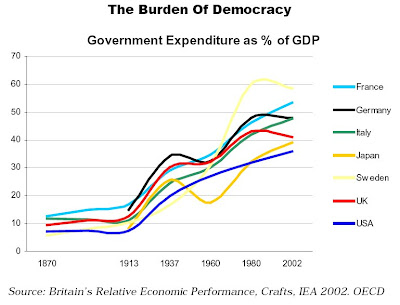
If this sounds doubtful, the following graph may be of note, demonstrating as it does the inexorable rise in Government expenditure in seven of the world’s leading democracies following the massive expansion of the franchise in the late C19th and early C20th.


The result is particularly hard to reverse because it generates a dependency culture, an addiction to the state as the solution to all our problems. “Liberty means responsibility,” observed George Bernard Shaw. “That is why most men dread it.” Throughout my lifetime every crisis – natural or man-made, financial, physical or moral – has been met with the demand that politicians take action. ‘Somebody should do something about this’ is a common cry among those who have lost the habit of asking ‘What can I do about this?’ So instead of buying our groceries in local shops we demand that regulators throttle the supermarkets; rather than choose a smoke-free pub we demand that smoking is banned in public places; rather than find a better job or undergo training we vote for tax-credits.

Democracy, as Churchill noted, “is the worst form of government except all the others”, and it is not my purpose nor is it Smith’s to argue that we should abandon democracy. But we need to remember that democracy exists to serve liberty – not vice versa. There is a reason why some of us consider ourselves Liberal Democrats. Of course there is a role for the state: classical liberalism is about limiting, not eliminating, it. We must uphold and even defend democracy, but we must be open minded about it, too, and ready to recognise its flaws. We have allowed democracy to run away with itself, and it has taken our freedom with it.

Craig F. Smith has some suggestions for how to restore liberty within democracy – though he admits that they may be pie-in-the-sky and will certainly not be easily accepted. However, there a more fundamental lesson to learn. We have given up too much of our freedom by perpetuating the myth that in choosing who leads us we invest them with unlimited power. We must limit the power of parliament and the executive and re-focus responsibility in society on individuals. Bernard Shaw was right that freedom worries people and places great responsibilities upon them. But I hope Thomas Jefferson spoke for us all when he stated that he “would rather be exposed to the inconveniences attending too much liberty than to those attending too small a degree of it.

NOTE: The title of this article borrows from the film Taking Liberties since 1997, but refers to the first imposition of Income Tax in Great Britain.

Thursday, 5 April 2007

Distance from power keeps us honest

In another piece of groundbreaking journalism, the Times has invited Big Brother and Manchester University psychologist Geoff Beattie to rate the honesty and evasiveness of British politicians.

It will be of no great surprise to Liberal Democrats to discover that their leader, Sir Menzies Campbell, gave direct and frank answers most frequently, while Home Affairs spokesman Nick Clegg was least likely to avoid the question.

Labour scored consistently badly, with all Government Ministers proving more evasive than Campbell or even the Conservative front bench. Interestingly, the most evasive politician of them all was the “straight talking” Home Secretary, John Reid.

But before we start pushing Foci through letterboxes and touting our honesty on doorsteps, we should note Beattie’s warning: “There is not some factor that make [the opposition] psychologically more straightforward than Labour.” Rather, they were affected by “the constraints of government”.

Thus, “I wouldn’t for a second say that Conservative [or, presumably, Liberal Democrat] politicians are more straight-talking. Once they get a chance to go back into government, I’m quite sure they will be equally evasive.”

Liberal Democrats often like to point out that they are a less venal bunch than the other parties, noting that nobody joins the Lib Dems because of a hunger for office or power. Perhaps by remaining on the opposition benches it also gives us the chance to be more honest and open. Every cloud has a silver lining.